LUFS is a way to measure how loud audio feels over time. Unlike a peak meter, which only shows the highest instant in a signal, a LUFS meter considers the level, frequency balance, channels, and duration of the sound. That makes LUFS useful when you want to compare the overall loudness of songs, videos, podcasts, or broadcast programs.
The most useful number for a finished track is usually Integrated LUFS. It summarizes loudness across the full measured program. If one master reads -14 LUFS and another reads -9 LUFS, the -9 LUFS master measures about 5 LU louder. That does not automatically mean it is better, more powerful, or more professional. It only tells you that its measured average loudness is higher.
What does LUFS stand for?
LUFS means Loudness Units relative to Full Scale. Full scale is the digital ceiling: audio cannot exceed it without clipping in a fixed-point digital system. LUFS values are normally negative because ordinary program material sits below that ceiling.
A reading closer to zero is louder. For example:
- -9 LUFS is louder than -14 LUFS.
- -14 LUFS is louder than -20 LUFS.
- A change of 1 LU is represented by a 1 dB change in measured loudness.
The measurement method comes from the ITU-R BS.1770 family of recommendations. The algorithm applies frequency weighting, combines channel energy, and uses gating rules for program loudness. The EBU uses the term LUFS in its R 128 loudness work. You may also see LKFS in other standards and meters; for practical reading, LKFS and LUFS represent the same scale.
LUFS is not the same as peak level
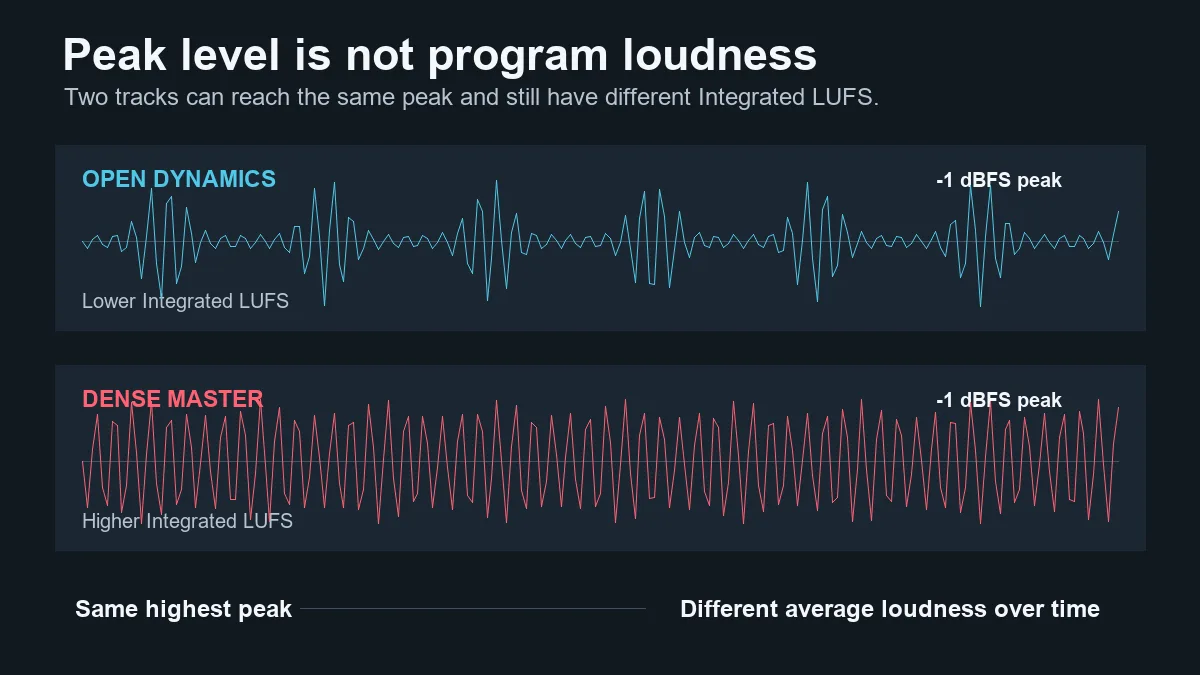
Peak level answers: What was the highest signal level? LUFS answers: How loud was the program over a period of time? These questions are related, but they are not interchangeable.
Imagine two tracks that both peak at -1 dBFS. The first has open verses, strong transients, and plenty of space between hits. The second is heavily compressed and stays near its peak for much more of the song. Their peak readings can be identical while the second track has a much higher Integrated LUFS reading and sounds consistently louder.
This is why a peak-normalized set of files can still jump noticeably in loudness from one file to the next. Peak meters remain essential for headroom and clipping checks, but they cannot describe perceived program loudness by themselves.
Integrated, Short-term, and Momentary LUFS
Most loudness meters show more than one LUFS value. Each one answers a different practical question.
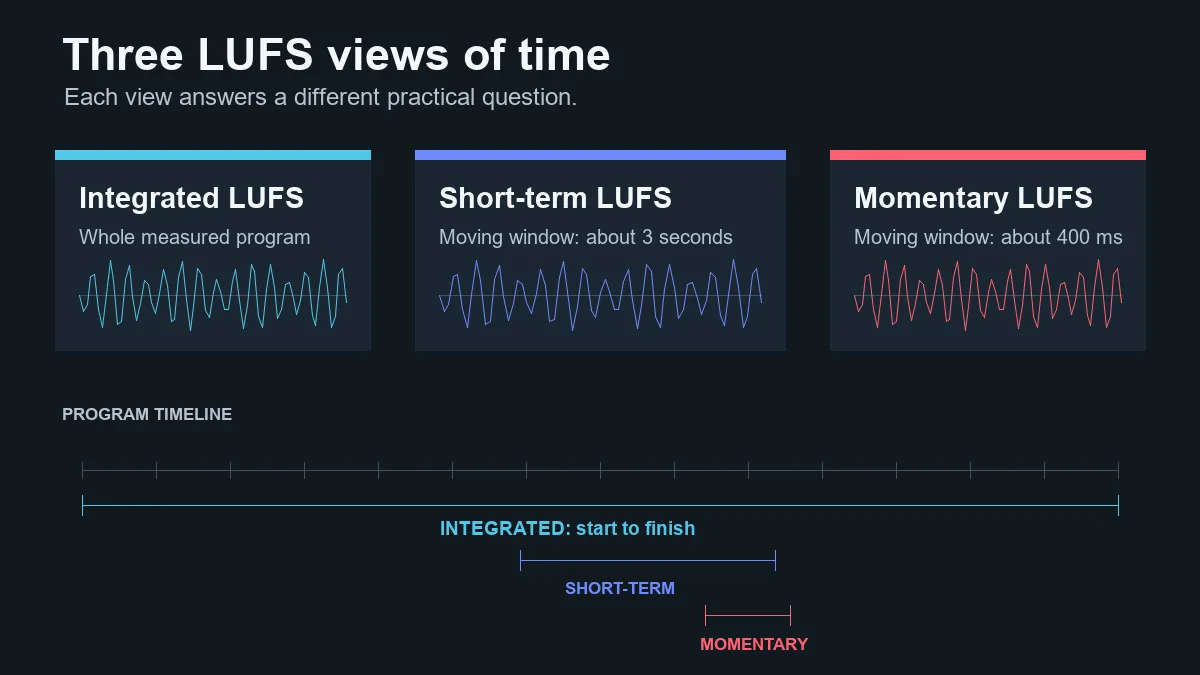
Integrated LUFS measures from the start of the measurement to the end. It is the main value used to describe an entire song, episode, or program. Start the measurement before playback and let the full piece run if you want a reliable whole-file result.
Short-term LUFS uses a moving window of about three seconds. It helps you see how loudness changes between a verse and chorus, between speakers, or between sections of a video. It moves slowly enough to be readable but quickly enough to reveal section-level changes.
Momentary LUFS uses a much shorter window of about 400 milliseconds. It reacts quickly to recent sound and is useful for watching immediate movement. It is not a replacement for the Integrated value when judging a complete master.
An easy way to remember them is:
- Integrated: the whole program.
- Short-term: the current section.
- Momentary: what is happening right now.
Why silence does not always pull the result down
A simple average would let long silence make a program appear much quieter than its active content. Standard loudness measurement therefore uses gating. Very quiet blocks are excluded according to defined rules, so a long silent lead-in or pause does not dominate the final Integrated reading.
Gating does not mean the meter ignores every quiet musical passage. It means the calculation tries to produce a useful program-loudness value instead of blindly averaging all samples. Measurement results can still change when you analyze only one section instead of the full program, so always compare like with like.
What does -14 LUFS mean?
-14 LUFS means that the measured program has an Integrated loudness of -14 Loudness Units relative to digital full scale. It is widely discussed because some streaming playback systems use loudness normalization near that area. It is not a universal mastering law.
Spotify, for example, states that its Normal playback setting adjusts tracks to -14 LUFS according to ITU 1770, while its other listener settings use different levels. It applies gain during playback rather than rewriting the uploaded master. Platform behavior can also depend on the playback setting, device, album context, and available peak headroom.
This leads to an important point: a platform target is not automatically the correct creative target for every master. A dense rock master, an acoustic recording, a podcast, a film mix, and a broadcast program can need different dynamics and delivery decisions. Loudness normalization can turn a loud master down, but it cannot restore dynamics that were removed during limiting.
We will cover the specific -14 LUFS question in a separate article. For now, treat it as a playback-normalization reference used in some contexts, not a score you must hit exactly.
LUFS, loudness range, and dynamics
Integrated LUFS tells you the average loudness result, but it does not describe the complete shape of the audio. Two tracks can share the same Integrated LUFS and still feel different because of arrangement, frequency balance, transient impact, stereo presentation, and contrast between sections.
Useful companion measurements include:
- True Peak, which estimates peaks that can occur between digital samples during conversion or playback.
- Loudness Range, which describes variation in loudness across a program.
- Peak-to-Loudness Ratio, which helps show the space between the loudness average and peak level.
- Section and channel balance measurements, which can reveal changes hidden by one overall number.
Use LUFS as one part of a measurement set. Do not let one number replace listening.
How to measure LUFS correctly
For a finished song or other complete file, follow a consistent process:
- Use the final exported file, not a random section from the project timeline.
- Measure the entire program when you need Integrated LUFS.
- Check that the meter follows an ITU-R BS.1770-compatible method.
- Read True Peak together with Integrated LUFS.
- Compare files that serve a similar purpose, not unrelated genres or formats.
- Listen at a stable monitoring level before changing compression or limiting.
If you change the master, measure the new export again. A limiter setting, gain adjustment, EQ move, or codec conversion can change the result.
Check your file with SolAudioLab Audio Analyzer
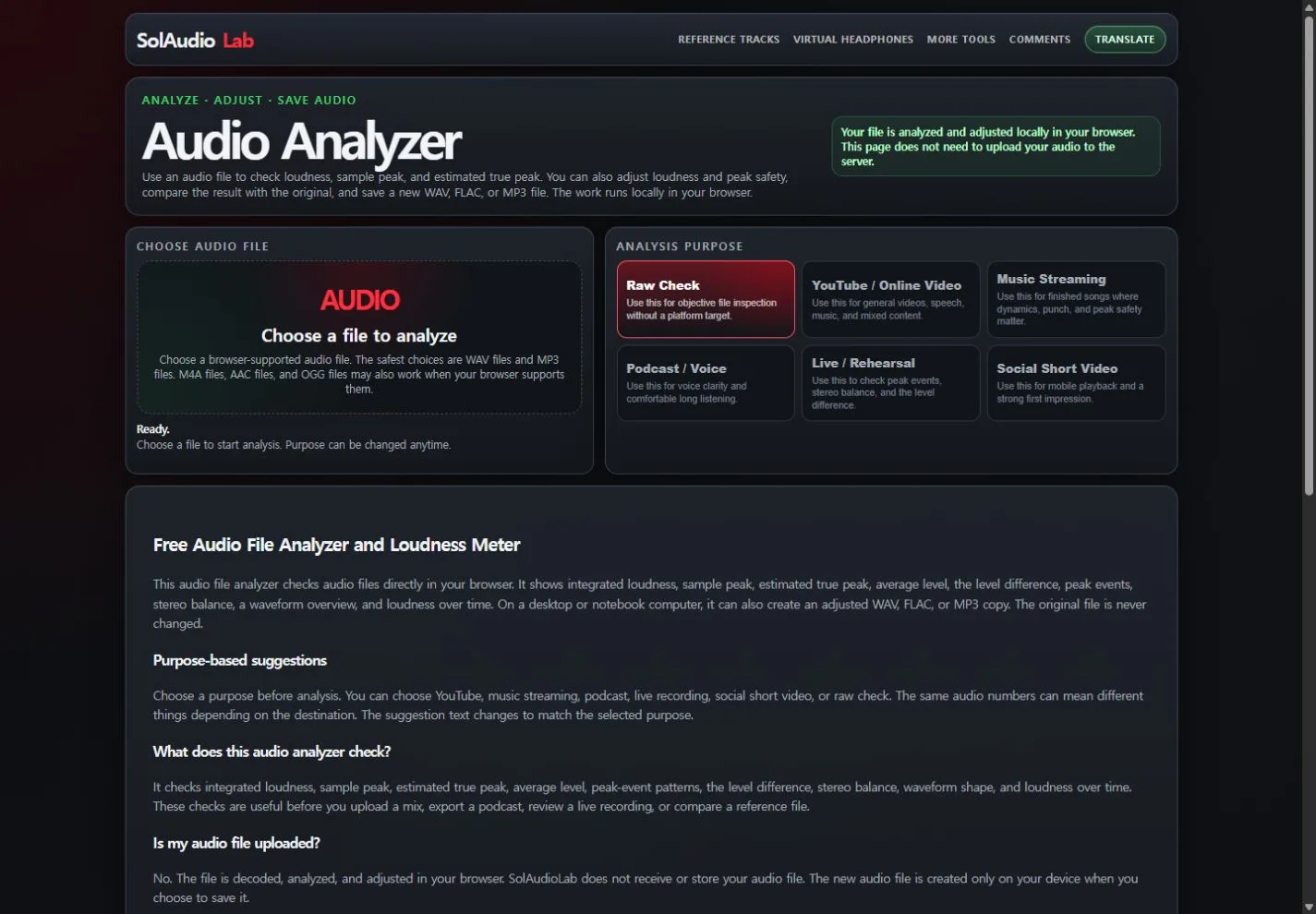
You can measure your own file in the SolAudioLab Audio Analyzer. The tool analyzes audio locally in your browser, so the original file is not uploaded to SolAudioLab. It reports Integrated Loudness, Estimated True Peak, peak-to-loudness information, dynamics, and other checks that help put the LUFS number in context.
Use this simple workflow:
- Open Audio Analyzer on a desktop or laptop.
- Load the final WAV, FLAC, or MP3 file.
- Let the full analysis finish.
- Note Integrated Loudness and Estimated True Peak first.
- Review the other results before deciding whether the master needs a change.
The goal is not to make every file display the same number. The goal is to understand what the measurement says, preserve the sound you want, and avoid technical problems in delivery.
The practical takeaway
LUFS gives you a repeatable way to discuss perceived program loudness. Integrated LUFS describes the whole measured piece, Short-term LUFS follows sections, and Momentary LUFS reacts to the immediate sound. Peak and True Peak remain separate measurements, so always read loudness and peak information together.
If you remember only one rule, remember this: LUFS is a measurement, not a mastering grade. Use it to make informed choices, then confirm those choices by listening.